
 Images
- Biography
- Images
- Movies
- Links
- Books
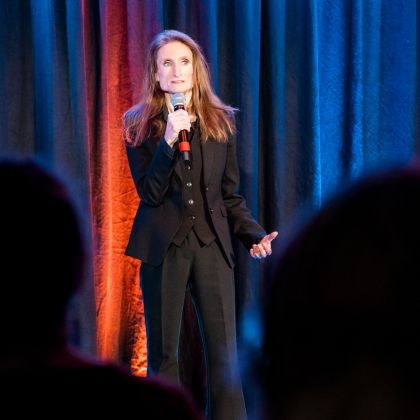
Dominique Giger – Rethinking leadership: clear, human, effective.
Today, leaders face pressures that would have been unthinkable just a few years ago: political crises, rapid change driven by artificial intelligence, and teams that need both direction and flexibility. Anyone leading in this environment needs more than just strategies – they need clarity about themselves.
Dominique Giger makes exactly that possible. She combines over 18 years’ experience in international change management with a Master’s degree in Computer Science from ETH Zurich, in-depth knowledge of psychology and neuroscience – and her own lived experience of resilience. What sets her apart from other leadership speakers is that she understands technology and people in equal measure – and knows how one influences the other.
Over 90% of our behaviour is unconscious. This ‘invisible iceberg’ determines leadership effectiveness, team dynamics and the success of transformation. Dominique Giger makes this hidden part visible – with tools that participants can apply on the very same day.
As an ETH computer scientist, she knows the systems side of digital transformation first-hand. As a leadership expert, she knows that the more powerful AI becomes, the more valuable become the things machines cannot do: critical thinking, emotional intelligence and human judgement. Her keynotes help leaders secure precisely these skills – in a world where AI is taking on more and more.
Her keynotes and workshops have one thing in common: participants don’t just leave feeling inspired – they go home with something tangible.
Her USP: Dominique Giger combines what is rare in the speaker market: technological depth (ETH Computer Science), scientific rigour (neuroscience, psychology), and over 18 years’ practical experience in international transformation projects. She doesn’t talk about theory – she provides tools that work in the next meeting.
Dominique Giger Lecture topics
All topics are available as a keynote speech (45–60 mins) or an interactive workshop.
1. Leading when nobody knows the answers
Clarity, trust and direction in uncertain times
When markets fluctuate, structures change and teams feel unsettled, leadership makes all the difference. Drawing on neuroscience and 18 years of practical experience, Dominique Giger shows how leaders can project confidence without pretending to have all the answers. How they can provide direction without feigning control. And how teams can grow closer together rather than falling apart in times of crisis.
TAKE-AWAYS:
- The 3C Framework: Communication template for periods of uncertainty – ready to use
- SCARF Model: Neurobiological diagnostic tool for assessing your own team atmosphere
- The principle of perceived over-communication: Why leaders systematically share too little – and how to change that
- Team Stability Framework: Vision/Why, team norms and rituals as internal stability
- Personal Stress Toolkit: Circle of Influence, 4-7-8 breathing, emotional anchors
- Clarity Card: Personal self-assessment for leadership situations
2. AI makes us faster – but are we still thinking for ourselves?
Critical leadership skills and human judgement in the age of artificial intelligence
The more powerful AI becomes, the more valuable become the things machines cannot do: genuine human connection, emotional intelligence – and critical thinking. Current research shows that as trust in AI grows, people’s judgement deteriorates. “Familiarity replaces critical distance. What appears helpful is no longer questioned.”
Dominique Giger – herself an ETH computer scientist – draws on insider knowledge and scientific rigour to demonstrate: Which leadership skills determine success in the AI era. How to use AI as a partner without losing one’s own judgement. And why emotional intelligence is not a soft skill, but a strategic competitive advantage.
TAKE-AWAYS:
- Clarity on which skills are indispensable in the AI era
- The “Think-First” framework: How to use AI strategically without outsourcing your own thinking
- Practical methods for developing emotional intelligence as a leader
- Re-defining your own leadership role in the digital transformation
- Concrete tools for critical judgement in AI-supported decision-making processes
What makes this keynote special:
Dominique Giger is neither an AI critic nor an AI evangelist. As a computer scientist at ETH Zurich, she understands the technology from the inside – and can therefore speak with authority about what AI can and cannot do. This approach is rare in the speaker market and inspires confidence in both tech-savvy and tech-sceptical audiences.
3. Mentally overwhelmed – why cognitive overload is the biggest decision-making pitfall for leaders
Brain-friendly leadership: recognising and reducing cognitive overload – and creating the conditions under which people can make good decisions
Many leaders aren’t simply short of time. They feel mentally overwhelmed. According to the GDI Global Leadership Forecast 2025, 71% of leaders feel heavily burdened by current demands – 40% have already considered stepping down from their roles.
There is often more to this than just stress: cognitive overload caused by too many stimuli, changing roles and multiple decisions to be made simultaneously. This is not merely a productivity issue. It is a quality issue. Because bad decisions often don’t look dramatic – they look harmless: too late, too hasty, too vague, too routine.
In this keynote, Dominique Giger takes an honest look at the research. No inflated figures, no sweeping generalisations. Instead: a clear understanding of what cognitive overload actually does in day-to-day leadership – and what really helps.
"Good decisions are not just a question of intelligence. They are a question of state."
TAKE-AWAYS:
- Why leaders feel ‘mentally overwhelmed’ – and what this means from a neurobiological perspective
- How interruptions, changes in context and decision fatigue actually impair the quality of decision-making
- Why poor decisions often go unnoticed: procrastination, default solutions, avoiding friction
- Three reflective questions for your own day-to-day leadership practice
- Practical structures and habits that reduce cognitive load – for yourself and the team
What makes this keynote special:
Dominique Giger deliberately avoids figures that sound good but are not scientifically sound. This honesty is her unique selling point: she clearly states what we know, what we don’t know – and what really helps. This builds trust with analytical, critical audiences.
4. Resilience is not a character trait – it can be learned.
Mental Strength for Leaders & Teams: Turning Pressure into New Energy
Burned-out teams, constant pressure, rising expectations: many respond by simply carrying on – and in doing so, lose sight of themselves. Dominique Giger provides immediately applicable methods for mental strength and demonstrates how resilience can be systematically built up – for individuals and entire teams. Not as theory, but drawn from lived experience.
What makes this unique: Dominique Giger avoids the usual resilience tips that individualise the problem. She demonstrates how resilience is actively fostered both on a personal level and through team structures, leadership behaviour and organisational conditions.
TAKE-AWAYS:
- Personal resilience check & individual action plan
- Emotional anchors: identifying and activating maintenance and repair anchors
- Tried-and-tested methods for dealing with anxiety, pressure and high expectations
- Get the Basics Right: sleep, exercise and social connections as the foundation of resilience
- Team strategies for collective resilience: rituals, psychological safety, a culture of learning from mistakes
Market differentiation:
The resilience market is saturated. Dominique Giger’s unique selling point is the combination of personal resilience experience, a neuroscientific foundation and an explicit systems perspective: resilience is not a character trait – it is enabled or hindered by structures.
5. What you see is not the problem
The invisible iceberg: What leadership must learn from psychology and neuroscience – and how to harness unconscious patterns for high performance
Conflicts, lack of motivation, resistance to change – the causes almost always lie beneath the surface. Over 90% of our behaviour is unconscious. Leaders who react only to what is visible address symptoms – but not causes.
Dominique Giger brings this hidden aspect to light. Drawing on insights from psychology and neuroscience, which she translates into language that requires no academic background. And with concrete tools to create high-performance cultures based not on control, but on trust.
TAKE-AWAYS:
- Behavioural models from psychology & neuroscience that can be applied directly
- Recognising and specifically changing your own unconscious patterns as a leader
- Understanding team dynamics beneath the surface: what really lies behind resistance
- Concrete levers for high-performance cultures without control mechanisms
- Diagnostic tool: where are the current unconscious blockages within the team?
Why Dominique Giger?
- Over 18 years’ experience in international change and transformation projects – working with Fortune Global 500 companies, SMEs, NGOs and start-ups.
- ETH Master’s in Computer Science: She understands technology not as an observer, but from first-hand experience. She has led digitalisation projects before AI was a buzzword.
- Scientific rigour: Dominique Giger deliberately avoids unsubstantiated figures and sweeping generalisations. This honesty is her unique selling point compared to the usual motivational market.
- Personal experience of resilience: For her, clarity and emotional intelligence are not just theory, but lived practice.
- Practical and immediately applicable: Participants leave not only inspired – they leave with concrete tools that work on the very same day.
- Bilingual: German and English – available internationally.
Dominique Giger is the voice of leadership in uncertain times.
She inspires leaders not to fear change, but to embrace it as an opportunity – and to lead their teams into the future with clarity, resilience and emotional intelligence.


